
In partnership with


What’s Inside
- Porter’s Montreal Pivot: A massive 12-route expansion at the newly renamed Montréal Metropolitan Airport (YHU).
- The Battle for Europe: Analyzing why Istanbul (IST) is poised to overtake London Heathrow (LHR) as the continent's busiest hub.
- Safety Analysis: A preliminary NTSB report on the Air Canada Express accident at LGA reveals critical ASDE-X technology failures.
- Fleet Renewals: Finnair places a multi-billion dollar order for Embraer E195-E2s to modernize its European network.
Access the full datasets, global fleet movements, and expert context relied on by industry leaders.

Tech moves fast, but you're still playing catch-up?
That's exactly why 200K+ engineers working at Google, Meta, and Apple read The Code twice a week.
Here's what you get:
Curated tech news that shapes your career - Filtered from thousands of sources so you know what's coming 6 months early.
Practical resources you can use immediately - Real tutorials and tools that solve actual engineering problems.
Research papers and insights decoded - We break down complex tech so you understand what matters.
All delivered twice a week in just 2 short emails.
Route Intelligence Report
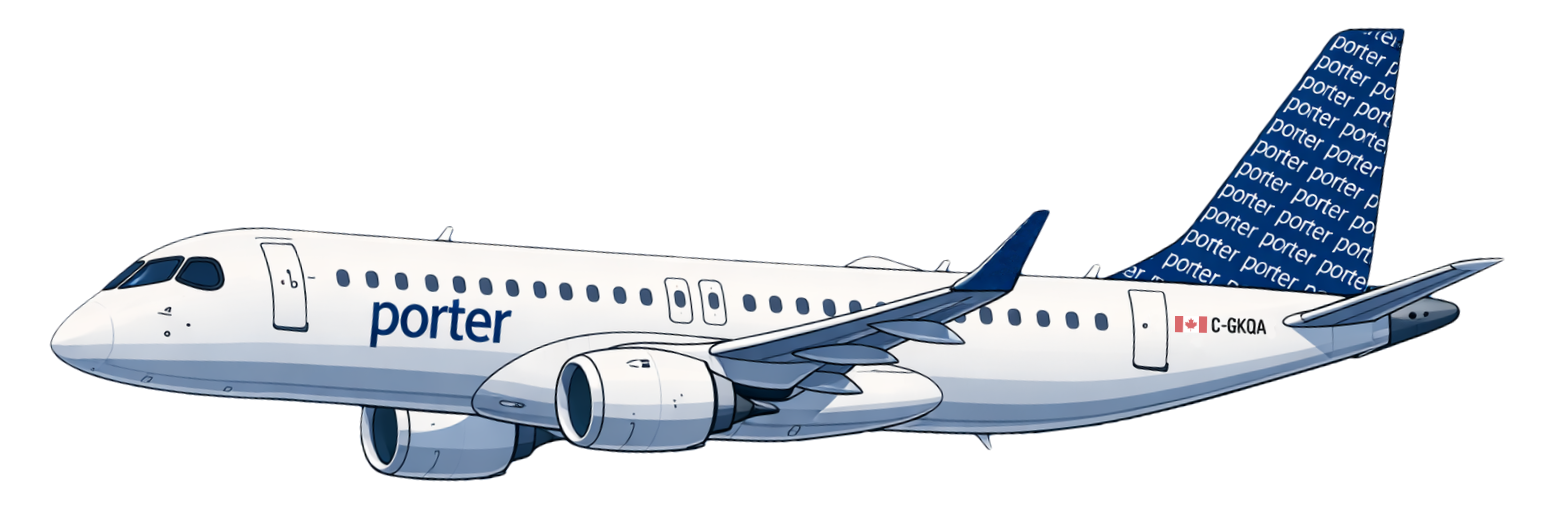
Porter Airlines (PD) is launching a major expansion at the newly renamed Montréal Metropolitan Airport (YHU) starting in June 2026. The initial schedule begins June 15, 2026, with the full cross-Canada network rolling out by June 22, 2026.
- Calgary (YYC)
- Charlottetown (YYG) – Seasonal
- Edmonton (YEG)
- Halifax (YHZ)
- Hamilton (YHM)
- Moncton (YQM) – Seasonal
- Québec City (YQB)
- St. John's (YYT) – Seasonal
- Toronto City (YTZ)
- Toronto Pearson (YYZ)
- Vancouver (YVR)
- Winnipeg (YWG) – Seasonal
These additions add a second gateway for the airline in the region alongside Montréal Trudeau (YUL). Routes will be served by a mix of De Havilland Dash 8-400 and Embraer E195-E2 aircraft. The new terminal at Montréal Metropolitan is specifically designed for a faster "curb-to-gate" experience, positioning it as a more efficient alternative to the larger Montréal Trudeau hub for point-to-point travelers.
Delta Airlines (DL) is adding daily flights from Los Angeles (LAX) to Palm Beach, Fla. (PBI) on November 20.
SkyWest Airlines (OO) will add double daily flights from Austin (AUS) to Phoenix (PHX) on November 9. This route will be operated by Embraer E175 equipment under the Delta Connection banner.

Fleet Intelligence
LATEST AIRCRAFT DELIVERIES
🇦🇪 A6-LRL, an Airbus A321-251neo, was delivered to Etihad Airways (EY) on March 23.
🇨🇳 B-228K, a Boeing 737 MAX 8, was delivered to China Southern Airlines (CZ) on March 25.
🇰🇷 HL8733, a Boeing 787-10 Dreamliner, was delivered to Korean Air (KE) on March 23.
🇰🇷 HL8752, a Boeing 737 MAX 8, was delivered to T'Way Air on March 24.
🇺🇸 N322VJ, a Boeing 737 MAX 8, was delivered to American Airlines (AA) on March 24.
🇺🇸 N37440, a Boeing 737 MAX 9, was delivered to United Airlines (UA) on March 23.
🇺🇸 N436FR, an Airbus A320-271neo, was delivered to Frontier Airlines (F9) on March 25.
🇺🇸 N47446, a Boeing 737 MAX 9, was delivered to United Airlines on March 25.
🇺🇸 N608DN, an Airbus A321-271neo, was delivered to Delta Air Lines on March 25.
🇺🇸 N701DH, an Airbus A321-271neo, was delivered to Delta Air Lines on March 23.
🇺🇸 N8999Q, a Boeing 737 MAX 8, was delivered to Southwest Airlines (WN) on March 24.
🇺🇸 N9000D, a Boeing 737 MAX 8, was delivered to Southwest Airlines on March 25.
🇺🇸 N917UP, a Boeing 767-300F, was delivered to United Parcel Service (UPS) on March 25.
LATEST AIRCRAFT RETIREMENTS
🇰🇷 HL8260, a Boeing 737-8BK with South Korea’s Jeju Air (7C), was withdrawn from use (wfu) and ferried on March 24 to St. Athan, Wales (DGX) for part-out and scrap.
Flightline Feature Stamp Collection |  |

|
✈ Support Flightline in 10 Seconds
Keep Flightline Flying
Click our Amazon link before you shop. No extra cost to you. A small commission for us. It helps fund the data, analytics, and server costs behind every Flightline issue.
|

|
Aviation Safety & Security
Over 460 Transportation Security Administration (TSA) screeners have now quit their jobs since the latest funding lapse began on February 14. Today marks 40 days since TSA employees began working without pay. Over 1,100 screeners quit during and after the October/November funding lapse that went a record 43 days. Indeed, TSA employees have worked nearly half the current fiscal year without regular paychecks.
As the youngsters would say, “you’ve gotta respect the hustle.” A man is offering to stand in the exceptionally long TSA lines at airports for a price, offering his services at either Atlanta (ATL), Houston Intercontinental (IAH), or New Orleans. Prices range from $600 - $1,200 and must be paid in advance. He asks for a week’s notice and of course, will trade his place before it’s time to show ID to the TSA screeners at the front of the checkpoint. People do this for concert tickets and such, so why not?
A National Transportation Safety Board (NTSB) investigator responding to the deadly Air Canada Express (AC) New York LaGuardia (LGA) accident Sunday was delayed for roughly three hours in a TSA security line in Houston, forcing officials to intervene and “beg” for expedited clearance. The delay, driven by severe TSA staffing shortages tied to the ongoing Department of Homeland Security (DHS) shutdown, hindered the agency’s ability to quickly deploy its investigative team to the accident site. The incident underscores how operational disruptions at TSA are now directly impacting time-critical aviation safety response efforts.
Delta Air Lines has suspended its "Specialty Services Department" perks for members of Congress, including private airport escorts, effective immediately. The decision comes as a response to the ongoing partial government shutdown, which has caused security wait times at Delta's Atlanta hub to exceed four hours. The airline stated that these services will remain suspended until federal funding is restored and TSA operations return to normal.
Aviation Industry News
ITA Airways (AZ) is set to officially join Star Alliance on April 1, 2026, marking a major milestone in its integration with the Lufthansa Group. This move completes the airline's transition from SkyTeam, following Lufthansa's acquisition of a 41 percent stake in the Italian carrier. As part of the shift, ITA will sunset its Volare loyalty program on March 30 and adopt Lufthansa’s Miles & More as its official frequent flyer program starting April 1. The integration will provide passengers with full Star Alliance benefits, including reciprocal mileage earning, reward redemptions, and elite perks like lounge access across the alliance’s global network.
Allegiant Air (G4) has introduced a temporary “Travel with Confidence” policy allowing passengers to change or cancel flights without fees as the ongoing government shutdown disrupts airport operations. The move comes as TSA staffing shortages driven by unpaid workers and elevated sick calls have led to long and unpredictable security wait times across the U.S., prompting airlines to offer greater flexibility. The policy applies to both new and existing bookings through the end of the shutdown, reflecting growing concern that extended screening delays are beginning to impact traveler demand and booking confidence.

United Airlines has unveiled a major narrow-body cabin upgrade tied to the introduction of its Airbus A321XLR and “Coastliner” A321neo fleets, both featuring the new United Elevated interior. The configuration brings true long-haul style amenities to single-aisle aircraft, including lie-flat United Polaris business class seats with all-aisle access and, for the first time on a narrow-body, a dedicated United Premium Plus cabin with a retractable divider. The aircraft will also feature the largest economy class seatback screens in the industry, expanded in-seat power throughout, and a self-serve snack bar, signaling a clear push to enhance premium seating options on transcontinental and longer-range narrow-body flying. United intends to accept over 250 new aircraft by April 2028.
Separately, United is introducing a new regional variant, the CRJ-450, a reconfigured CRJ-200 fitted with 41 seats including a First Class cabin. The move allows United to better align with scope clause limits while still offering a premium product on smaller markets. The aircraft, operated by SkyWest Airlines under the United Express standard, is expected to enter service this fall from Chicago O’Hare (ORD) and Denver (DEN), targeting thinner routes where mainline capacity would be uneconomical. EDITOR’S NOTE: The CRJ-500 that underwent a similar transformation was subsequently labeled a CRJ-550. If you are wondering why these upgraded CRJ-200s are not CRJ-250s instead of 450s, you are not alone.
U.S. travel agency air ticket sales reached $9.6 billion in February 2026, marking an 11 percent increase over the previous year following a record-breaking January. According to the latest Airlines Reporting Corp. (ARC) data, total passenger trips rose eight percent year over year to 25.9 million, even as travelers managed significant winter weather disruptions. Domestic trips grew nine percent to 16 million, while international trips rose seven percent to 9.9 million.
EDITOR’S NOTE: A Personal Reflection from MTY: Working from Monterrey this week, it’s impossible not to notice the sheer scale of the evolution here. I first visited Monterrey in late 2012 when Viva Aerobus (as it was known back then) was still operating out of a repurposed cargo warehouse with a fleet of legacy 737-300s. Fast forward to 2026: Viva is a powerhouse with a massive A321neo fleet, OMA is executing an $800 million expansion, and the airport is prepping for the world stage of the 2026 World Cup. Monterrey is also finally adding a long-awaited rail link to Monterrey International Airport (MTY) via the Metrorrey Line 6 expansion, which will provide a one-seat ride from downtown and reduce reliance on road access. It is the perfect case study in how infrastructure and a “Low-Cost” mindset can rewire a regional economy.
Pricing trends showed the average U.S. round trip ticket price increased seven percent year over year to $601. Average economy fares reached $539, while premium class tickets averaged $1,423. Leisure-focused and online travel agencies saw trip growth of six percent and three percent respectively, while corporate agency sales remained flat. Additionally, New Distribution Capability (NDC) transactions continued their upward trajectory, accounting for 21 percent of all ARC settled transactions, up from 19.1 percent in February 2025. For the first time since September 2025, every ARC agency segment met or exceeded its year over year passenger trip levels, signaling a broad-based resilience in travel demand despite seasonal volatility.

Heathrow’s Million-Passenger Club: The Global Hub at the Limit
Today we are diving into the 2025 performance data for the United Kingdom’s primary gateway. While several airports across the country see significant traffic, London Heathrow (LHR) exists in a category of its own, serving as the essential bridge for both high-value Origin and Destination (O&D) traffic and critical global transfers.
In 2025, Heathrow alone supported 25 routes that each surpassed the one million passenger threshold. These corridors represent the lifeblood of international commerce and tourism, connecting London to the world’s most influential financial and transit hubs.
Heathrow’s Million-Passenger Routes (2025)
The following destinations saw over one million travelers from Heathrow last year:
North America: New York (JFK), Los Angeles (LAX), Toronto Pearson, Boston (BOS), Chicago O’Hare (ORD), Miami (MIA), San Francisco (SFO)
Middle East & Asia: Dubai (DXB), Doha (DOH), Delhi, Singapore (SIN), Mumbai (BOM), Hong Kong (HKG), Abu Dhabi (AUH)
Europe: Dublin (DUB), Madrid (MAD), Amsterdam (AMS), Frankfurt (FRA), Munich (MUC), Istanbul (IST), Paris (CDG), Zurich (ZRH), Lisbon (LIS), Geneva (GVA)
Domestic: Edinburgh (EDI)
The Battle for the European Crown: LHR vs. IST
Despite a record-breaking 2025 that saw 84.5 million passengers pass through its terminals, Heathrow is facing a historic challenge to its title as Europe’s busiest airport. Istanbul Airport finished 2025 just 40,000 passengers behind Heathrow, and recent data from early 2026 shows that the "Sultan at the crossroads" has already begun outpacing the UK hub in monthly volume.
Heathrow CEO Thomas Woldbye has publicly acknowledged that IST will likely surpass Heathrow this year. However, this shift is less a change in passenger preference and more a reflection of absolute physical limitations.
Capacity vs. Ambition
The divergence between the two hubs illustrates two very different aviation realities:
Heathrow’s Ceiling: Heathrow has been operating at 98% capacity for years. With only two runways and a highly congested airspace, growth is currently achieved almost exclusively through "gauge pressure"—airlines swapping smaller narrow-bodies for larger, fuller aircraft. While a third runway has received a renewed push from the UK government, it is not expected to be operational until the mid-2030s.
Istanbul’s Horizon: In contrast, Istanbul was designed for massive scalability. With five active runways and a geographical position that perfectly captures flows between Europe, Asia, and Africa, Istanbul has the "room to run" that Heathrow lacks.
A Shift in Patterns?
While Heathrow remains the world’s most connected hub for premium North Atlantic traffic, the rise of Istanbul signals a broader eastward shift in the European aviation center of gravity. As London remains "slotted out," airlines are forced to look elsewhere for growth. If current trends hold, 2026 will be remembered as the year the primary gateway to Europe moved from the Thames to the Bosphorus—not because people stopped wanting to fly to London, but because there simply wasn't any room left for them to land.
Frankfurt is widening its reach for the Summer 2026 season, solidifying its spot as the undisputed heavyweight of German aviation. With 88 carriers linking to 283 destinations across 92 countries, the hub is moving beyond recovery and into a massive phase of global synchronization.

Finnair (AY) on Monday placed a major narrow-body fleet bet on Embraer, ordering 18 E195-E2 aircraft with options for 16 more and purchase rights for an additional 12, bringing the potential total to 46 aircraft. The deal represents one of the airline’s largest investments in over two decades and is part of a broader fleet renewal strategy focused on right-sizing capacity across its European network. Deliveries of the 134-seat jets are scheduled to begin in 2027, with the aircraft expected to replace older regional types while improving economics and flexibility. Finnair cited the E195-E2’s efficiency and environmental performance, offering up to 30–35 percent lower fuel burn and emissions versus previous-generation aircraft, as a key driver in the selection. While Finnair did not disclose a firm contract value, its total fleet investment program tied to the order is expected to reach approximately $2.3 billion through 2029, underscoring a decisive shift toward sub-150 seat aircraft as airlines recalibrate post-pandemic network strategies.
Enjoying This Issue?
Support Flightline and independent aviation journalism with a small contribution to help cover the costs of producing issues like this.
Thank you for being part of the Flightline community.

Wizz Air (W6) has begun phasing out its Airbus A321ceo fleet as part of a broader modernization strategy, with 41 aircraft set to be retired by March 2029 despite an average age of just nine years. The move accelerates the carrier’s transition toward a near all-neo fleet, centered on the A321neo and A321XLR, which offer lower fuel burn, reduced emissions, and improved operating economics. Currently about 75 percent of the fleet already consists of new-generation aircraft, with that figure expected to approach 100 percent by the end of the decade, reinforcing Wizz Air’s focus on cost efficiency and maintaining one of Europe’s youngest fleets.
Ecuador’s General Directorate of Civil Aviation (DGAC) has implemented a temporary 50 percent restriction on Jet A-1 fuel supply at the Quito (UIO) and Guayaquil (GYE) airports, effective until Saturday. The measure follows a production deficit at the Esmeraldas Refinery, exacerbated by a fire on March 1, and delays in fuel imports. To manage the shortage, authorities are prioritizing air ambulances, State aircraft, and emergency flights while urging commercial airlines to adopt "tankering" strategies by fueling up at origin or alternate airports. These constraints may lead to reduced passenger and cargo capacity or unscheduled technical stops for long-haul routes as the country works to stabilize its national reserves.
January 2026 Airport Passenger Totals
Below is a graph showing the 50 busiest airports in the world for January 2026.
🔒 Paid subscribers receive the full dataset which covers nearly 800 airports in over 80 countries. Upgrade now for complete visibility.

 Visit the World Record Spotters Logbook
Air Canada Express Accident
On the night of Sunday, March 22, 2026, a Bombardier CRJ900 operated by Jazz Aviation (QK) as Air Canada Express Flight 8646 was involved in a fatal runway collision at New York LaGuardia.
The aircraft, arriving from Montreal Trudeau with 72 passengers and 4 crew members, struck a Port Authority Aircraft Rescue and Firefighting (ARFF) vehicle on Runway 4 at approximately 11:38 p.m.
NTSB Update: Safety System Failure
The National Transportation Safety Board (NTSB) released a preliminary update on Tuesday, March 24, highlighting a critical failure of the airport's primary safety technology.
ASDE-X Failure: The Airport Surface Detection Equipment (ASDE-X), designed to alert controllers of potential runway incursions, failed to generate an alarm.
The Cause: NTSB Chair Jennifer Homendy stated the system could not create a "track of high confidence" due to the close proximity of multiple vehicles merging near the runway.
Missing Equipment: Crucially, the fire truck involved (Truck 1) was not equipped with a transponder, a factor that severely limited the system’s ability to track it and trigger an automated warning.
The Flight Deck
Investigation into the Cockpit Voice Recorder (CVR) and ATC logs indicates that the flight crew followed all proper protocols:
Cleared to Land: The pilots were cleared to land on Runway 4 nearly two minutes before the collision.
Sudden Incursion: Just 25 seconds before impact, the fire truck requested to cross the active runway to respond to a separate "odor" emergency on a United Airlines flight. A controller granted that request 20 seconds before impact — while the Air Canada jet was less than 100 feet above the ground.
No Warning: The fire truck appeared "out of nowhere" in the path of the jet. While controllers frantically shouted "Stop, Truck 1!" in the final 9 seconds, it was too late.
Heroic Actions: Passenger accounts and flight data suggest the pilots braked with maximum effort immediately upon touchdown. Their quick reflexes likely prevented the aircraft from veering off the runway or suffering an even more catastrophic breakup.
Casualties and Condolences
The collision sheared off the cockpit and forward galley. It is with heavy hearts that we name the two aviators lost in the line of duty:
Captain Antoine Forest, 30, of Coteau-du-Lac, Quebec.
First Officer MacKenzie Gunther, 38, of Peterborough, Ontario.
Forty-one others were hospitalized, including a flight attendant who was miraculously found alive on the tarmac after being ejected from the aircraft in her jumpseat.
A Note from Flightline
Our Monday edition was already complete and set to mail before this tragedy occurred, which is why there was a delay in our coverage.
Flightline extends its deepest condolences to the families and colleagues of Captain Forest and First Officer Gunther. We stand with the Jazz Aviation and Air Canada communities during this incredibly difficult time.
Air Cargo
AerCap has signed lease agreements with Ethiopian Airlines (ET) for two Boeing 777-300ERSF converted freighters, marking the first deployment of the type in Africa, with deliveries scheduled for the second quarter of 2028. The aircraft, a converted 777-300ER often referred to as the “Big Twin,” offers roughly 25 percent more capacity than smaller twin-engine freighters, providing improved operating economics on long-haul cargo routes. The addition will significantly expand Ethiopian’s cargo capabilities as it continues to scale its freight network and capitalize on sustained global demand, further strengthening its position as Africa’s leading cargo operator.
📈 Flightline Financials 🏦
|
Airline & Airport Operator Stock Prices Closing Price: March 20, 2026 |
|||
|
AAL American $10.72 |
AERO AeroMexico $13.73 |
ALGT Allegiant $84.59 |
ALK Alaska $39.16 |
|
BA Boeing $199.82 |
CPA Copa $115.94 |
DAL Delta $67.72 |
EMBJ Embraer $58.77 |
|
JBLU JetBlue $4.79 |
LTM LATAM $49.82 |
LUV Southwest $40.41 |
RJET Republic $17.66 |
|
RYAAY Ryanair $61.53 |
SNCY Sun Country $17.11 |
SKYW SkyWest $94.14 |
UAL United $93.22 |
|
ULCC Frontier $3.70 |
VLRS Volaris $7.62 |
BRENT CRUDE OIL Per Barrel $103.07 |
|
|
ASR Asur $340.66 |
OMAB OMA $117.22 |
PAC GAP $251.92 |
CAAP Corp America $25.97 |
|
Global Currency Exchange Rates $1 USD Equals: |
|||
|
EUR Euro 0.86 |
GBP British Pound 0.75 |
MXN Mexican Peso 17.90 |
CAD Canadian Dollar 1.37 |
Daily Passenger Counts at U.S. Airports, 2026 vs. 2025

✈ A Note of Thanks
Flightline is written for readers who care deeply about commercial aviation, from routes and fleets to security, policy, and data. Subscriber support allows this publication to remain independent, focused, and free of advertising influence.
If you find Flightline valuable, sharing it with a colleague or fellow aviation enthusiast is the simplest way to help it grow responsibly.
🔗 Follow Flightline
2025 Global Traffic Report
Passenger totals for nearly 1,300 airports across
120+ countries in one searchable file.
Bluesky | Instagram | Facebook | X | LinkedIn
Flightline.news
Have a news tip to share? Send anonymously via Signal to Flightline.47
